Spring Lawn Care Guide for Langley and Fraser Valley Homeowners

Spring Lawn Care Guide for Langley and Fraser Valley Homeowners
Why Spring Is the Most Important Lawn Care Season in the Fraser Valley
No region in Canada transitions from winter to growing season quite like the Fraser Valley. While Alberta and Ontario lawns emerge from months of sustained freeze, Langley and Surrey lawns come out of winter compacted, saturated, and often mossy after months of heavy rainfall and repeated freeze-thaw cycling. The work you do in March and April determines how your lawn performs for the entire growing season.
This guide covers the complete Fraser Valley spring lawn care sequence — aeration, dethatching, top dressing, overseeding, and mulching — with specific timing, quantities, and product recommendations for local conditions.
The Fraser Valley Spring Lawn Calendar
| When | Task | Why It Matters |
|---|---|---|
| Late February – March | Rake and remove winter debris | Removes matted grass that prevents airflow and encourages moss growth |
| Mid-March | Assess lawn condition | Identify bare patches, thin areas, moss, compaction zones before starting work |
| Late March – April | Aerate | Breaks compaction from winter rain and foot traffic, opens soil for air and water |
| Late March – April | Dethatch (if thatch > 1/2 inch) | Thatch blocks water, air, and new seed from reaching soil surface |
| April (after aerating) | Top dress with topsoil or soil mix | Levels uneven areas, improves soil quality, supports new seed germination |
| April | Overseed bare and thin areas | Fills gaps, thickens lawn, creates natural weed competition |
| April – May | Mulch garden beds | Suppresses spring weeds before they establish, retains moisture through summer |
| Late April – May | First fertilizer application | Feeds grass as it enters active growth phase after winter dormancy |
Step 1: Aeration — The Most Overlooked Step
Aeration is the most impactful single thing you can do for a Fraser Valley lawn. Our region’s heavy winter rainfall saturates soil and winter foot traffic compacts it. Compacted soil cannot absorb water efficiently, which means spring rains run off rather than soak in — worsening the very conditions that cause moss, bare patches, and poor grass density.
Core aeration — using a machine that physically removes plugs of soil — is far superior to spike aeration for Fraser Valley clay-heavy soils. The cores should be left on the lawn surface to break down naturally unless your soil is very poor quality, in which case removing them before top dressing gives you a cleaner starting surface.
Ideal timing: when the soil has warmed but is not saturated — late March to mid-April in most Langley, Surrey, and Abbotsford conditions. Aerating into waterlogged soil causes more compaction, not less. If the soil sinks 2 to 3 inches easily when you push a screwdriver in, it is ready to aerate.
Step 2: Top Dressing
What top dressing does
Top dressing — spreading a thin layer of soil over the entire lawn surface — serves three purposes in the Fraser Valley: it levels minor undulations that accumulate from freeze-thaw cycles, improves soil organic content, and provides a seedbed for overseeding. Applied after aeration, the soil filters down into the holes created by the aerator and makes direct contact with the root zone.
How much to apply
For standard top dressing: 1/4 to 1/2 inch of topsoil spread evenly. The target is to cover the soil without burying the grass — the grass blades should still be visible through the top dressing layer. Thicker applications smother grass and delay recovery.
| Lawn Area | 1/4 inch deep | 1/2 inch deep | 3/4 inch deep |
|---|---|---|---|
| 500 sq ft | 0.4 yards | 0.8 yards | 1.2 yards |
| 1,000 sq ft | 0.8 yards | 1.5 yards | 2.3 yards |
| 1,500 sq ft | 1.2 yards | 2.3 yards | 3.5 yards |
| 2,000 sq ft | 1.5 yards | 3.1 yards | 4.6 yards |
| 3,000 sq ft | 2.3 yards | 4.6 yards | 6.9 yards |
Which soil product to use
For standard lawn top dressing, topsoil or garden blend from Langley Landscape Centre ($55/yard) is appropriate. For lawns on heavy clay or with chronic drainage problems, mix soil amender ($65/yard) into the top dressing at a ratio of one part amender to two parts topsoil. This gradually breaks down the clay structure over multiple seasons.
How to spread it
Wheelbarrow the material in piles across the lawn and spread with a lawn rake or the back of a garden rake. Work it into the aeration holes and smooth to an even depth. Water lightly after top dressing to settle the material before overseeding.
Step 3: Overseeding
Overseeding adds new grass seed to the existing lawn to fill bare patches and increase density. A thicker lawn crowds out weeds and moss naturally, reducing the need for chemical treatments. The timing of overseeding relative to top dressing is important: seed after top dressing so seeds have contact with fresh soil rather than dry thatch.
Fraser Valley grass seed selection
Cool-season grass mixes perform best in the Lower Mainland. Look for blends containing perennial ryegrass and fine fescue, which handle both the wet winters and dry summers of the Fraser Valley. Avoid Kentucky bluegrass-dominant mixes — they require more summer heat than Langley conditions typically provide for full establishment.
Timing
In Langley and Surrey, soil temperatures reach the 10 to 12 degree Celsius threshold needed for cool-season grass germination in mid-April in most years. Overseeding before soil has reached this temperature results in poor germination. A simple thermometer inserted 2 inches into the soil gives you an accurate reading — do not rely on air temperature, which warms faster than soil.
After overseeding
Keep the seeded area consistently moist for three to four weeks until germination is complete. Light daily watering is better than occasional deep watering during this period. Do not mow until new grass reaches 3 inches. Do not apply weed control products for at least eight weeks after overseeding — they will damage new seedlings.
Step 4: Mulching Garden Beds
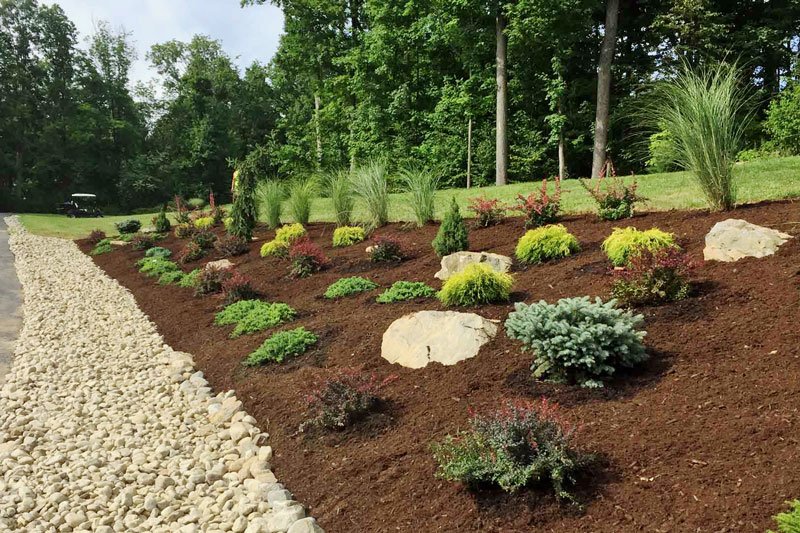
While lawn work is underway, mid to late April is the ideal window to mulch garden beds for the summer season. Mulching at this point gives you three benefits: it suppresses weed seeds that are just beginning to germinate, retains the soil moisture you have built up through spring rain, and protects plant roots from May temperature swings.
Mulch depth for spring application
New beds: 3 inches is the standard depth — the minimum required for effective weed suppression. Established beds with existing mulch: assess depth first. If more than 1 inch of old mulch is present, add only 1 to 1.5 inches on top. Excess depth (over 4 inches) suffocates roots and causes waterlogging in Fraser Valley conditions.
Which mulch to choose in spring
Red bark mulch ($53/yard) is the most popular spring choice for presentation beds. Aged mulch ($44/yard) is preferred for vegetable gardens and beds that benefit from soil enrichment. For sloped beds that experience runoff from spring rain, bark nuggets ($65/yard) resist displacement better than shredded bark.
Dealing with Moss
Moss in Fraser Valley lawns is almost always a symptom of underlying conditions — compaction, poor drainage, deep shade, or acidic soil — rather than a problem that moss treatments alone can solve. Kill moss with a ferrous sulphate treatment in early spring, but follow immediately with the steps above: aeration, top dressing, and overseeding. Without fixing the underlying conditions, moss will return within a season.
For lawns with persistent shade moss from large trees or fences, consider shifting to a fine fescue seed mix, which performs better in lower light conditions. Alternatively, replace struggling lawn in deep shade with bark mulch and shade-tolerant ground cover plants.
Ordering Spring Lawn Materials from Langley Landscape Centre
We carry topsoil, garden blend, soil amender, red bark mulch, aged mulch, bark nuggets, and playground chips — all available by the cubic yard with delivery to Langley, Aldergrove, Surrey, and Abbotsford. Spring is our busiest season. Order in March to secure your preferred April delivery date.
Order online at langleylandscapecentre.ca or call (604) 735-5333. Open daily 7 AM to 7 PM, including spring weekends. Pick-up at 24460 Fraser Hwy, Langley — drive in any time we are open.