Types of Bark Mulch: A Fraser Valley Homeowner’s Guide to Choosing the Right One

Why Mulch Choice Matters More Than Most Gardeners Think
Walk through any established garden in Langley, Surrey, or Abbotsford in late spring and you can tell immediately which properties were mulched correctly and which were not. The right mulch at the right depth transforms a garden bed — weed pressure drops to near zero, soil moisture is retained through July and August, and plant roots are insulated against the freeze-thaw cycles that Fraser Valley winters deliver.
The wrong choice — or the wrong depth — and you are weeding through June, watering twice a week, and potentially dealing with root rot from mulch piled against plant stems. This guide covers every bark mulch product available at Langley Landscape Centre, what each one is genuinely good for, and exactly when not to use it.
The Science Behind Mulch: What It Actually Does
All bark mulch performs four core functions regardless of type. Understanding these helps you evaluate which product suits your specific situation.
| Function | How It Works | Required Depth |
|---|---|---|
| Weed suppression | Blocks sunlight from reaching weed seeds in the soil surface. Below 2 inches, effectiveness drops significantly. | Minimum 3 inches |
| Moisture retention | Reduces soil surface evaporation by up to 70 percent, dramatically reducing summer watering needs. | 2–3 inches |
| Temperature regulation | Insulates soil against summer heat and winter frost. Root zone stays several degrees warmer in winter. | 2–3 inches |
| Soil building | As mulch decomposes it adds organic matter. Finer, aged mulches decompose faster and feed soil more actively. | Renew annually |
One critical warning: never mound mulch against the base of trees, shrubs, or plant stems. This practice — called volcano mulching — traps moisture against bark, creating conditions for fungal disease, insect damage, and long-term structural decline. Leave a 2 to 3 inch gap around every stem and trunk.
Red Bark Mulch — The Fraser Valley Default
What it is
Shredded Douglas fir bark, dyed to a rich red-brown colour using iron oxide pigment. Screened to a uniform particle size for even coverage. At $53 per cubic yard, it is the most popular product in our yard by volume, particularly from late March through May when spring planting drives peak demand.
Best for
Residential garden beds, front yard landscaping, boulevard strips, tree rings, and shrub borders. Anywhere visual presentation matters and you want a clean, finished look that photographs well.
Colour lifespan
The dyed red-brown colour holds well for one to two seasons. South-facing beds in direct sun fade faster — sometimes within one season. After fading, red bark becomes a warm natural brown that many gardeners prefer. Annual top-up with 1 to 2 inches in spring is standard practice.
When not to use it
Red bark mulch uses a synthetic dye. While iron oxide dye is generally considered safe, if you prefer an undyed product for vegetable gardens or children’s play areas, choose aged mulch or garden path wood mulch instead.
3/8″ Aged Mulch — The Soil Builder
What it is
Finely screened composted bark mulch that has been aged — partially broken down — before bagging and delivery. The ageing process gives it a darker, richer colour than fresh bark and a finer, more uniform texture. At $44 per cubic yard it offers good value for soil-focused applications.
Best for
Vegetable gardens and fruit bed top dressing, flower borders where soil enrichment matters, and established garden beds that benefit from organic matter input. The fine particle size breaks down faster than coarser mulches, feeding soil organisms and improving soil structure over a single season.
Fraser Valley specific benefit
Many Langley and Surrey properties have heavy clay subsoil. Annual application of aged mulch to garden beds — working it lightly into the surface — gradually builds the organic content and drainage characteristics of native soil. Over three to five years this transforms heavy clay into a workable growing medium.
Brite Bark Mulch (1 Inch) — The Bright Natural Look
What it is
One-inch screened bark mulch without dye, in a bright natural bark colour that is lighter and more golden-toned than aged mulch. At $44 per cubic yard, it occupies the middle ground between the dramatic colour of red bark and the earthy tone of aged mulch.
Best for
Garden beds and pathway borders where you want a natural, undyed appearance with good weed coverage. Works particularly well in shaded garden areas where the lighter colour brightens the space visually.
2–3 Inch Bark Nuggets — Long-Lasting Depth
What it is
Larger bark chunks in the 2 to 3 inch size range. At $65 per cubic yard, these are more expensive than shredded bark but decompose significantly more slowly, reducing annual replenishment requirements.
Best for
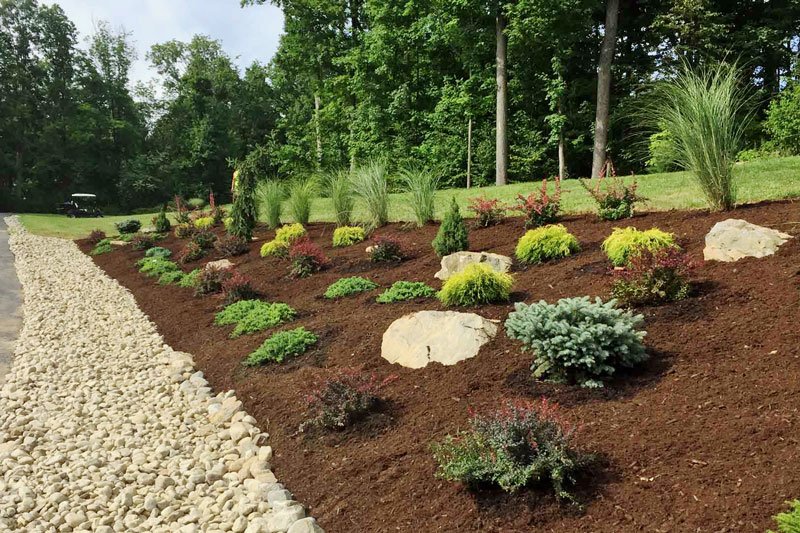
Slopes and hillside plantings where smaller bark can wash away during heavy rainfall. Shrub borders and established tree plantings that do not require regular cultivation. Larger planting areas where a rougher, more naturalistic aesthetic is preferred. High-rainfall Fraser Valley winters make bark nuggets particularly practical for sloped properties in Langley and Abbotsford — the larger pieces resist displacement much better than finer mulch.
Limitation
The larger particle size reduces weed suppression effectiveness compared to fine bark at the same depth. For maximum weed control on slopes, use bark nuggets at 4 to 5 inches rather than the standard 3 inches.
Garden Path Wood Mulch — The Practical Choice
What it is
Coarser wood mulch, undyed, at $32 per cubic yard — the most affordable bark product in our range. Particle size varies, giving it a more rustic appearance than screened bark products.
Best for
Garden pathways and walking trails, utility areas and side yards, ground cover under decks and fences, and any application where aesthetics are secondary to function and cost-efficiency. At $32 per yard it is the right choice for large areas where budget matters more than visual finish.
When not to use it
Front yard garden beds, commercial or presentation plantings, or anywhere the aesthetic of the mulch matters. Garden path mulch has an inconsistent appearance that reads as unfinished in formal settings.
Playground Chips — Safety First
What it is
Specifically processed wood chips engineered for safe-fall surface applications. Not decorative bark — these are produced to meet CSA Z614 playground safety standards. At $75 per cubic yard they are the most expensive bark product, and correctly so — the processing and certification add genuine safety value.
Best for
Under residential and commercial play structures, in backyard play areas, and beneath trampolines and swing sets. The loose, uncompacted structure of playground chips is what provides safe-fall protection. Playground chips should not be compacted or wetted heavily — the air space in the material is the functional component.
Critical depth requirements
Minimum 9 inches for equipment up to 5 feet high. Minimum 12 inches for equipment over 5 feet. Extend the surface at least 6 feet beyond the equipment perimeter in every direction. These are not suggestions — they are the CSA standard for safe-fall performance. Under-installation is the most common mistake and the one with the most serious consequences.
Bark Mulch Comparison at a Glance
| Product | Price/Yard | Best Use | Decomp Rate | With Dye? |
|---|---|---|---|---|
| Red Bark Mulch | $53 | Garden beds, borders, visual presentation | Moderate | Yes |
| 3/8″ Aged Mulch | $44 | Vegetable gardens, soil building, flower beds | Fast | No |
| Brite Bark (1″) | $44 | Natural-look beds, shaded gardens | Moderate | No |
| Bark Nuggets (2–3″) | $65 | Slopes, shrub borders, naturalistic areas | Slow | No |
| Path Wood Mulch | $32 | Pathways, utility areas, large budget jobs | Variable | No |
| Playground Chips | $75 | Play areas — safe-fall surface only | Moderate | No |
How Much Mulch Do You Need?
The coverage formula for any bulk mulch: Length (ft) × Width (ft) × Depth (inches) ÷ 324 = cubic yards.
For most garden beds, 3 inches is the target depth. One cubic yard covers approximately 100 square feet at 3 inches. For annual top-up on existing beds (adding 1.5 inches), one cubic yard covers approximately 200 square feet.
Not sure? Call us at (604) 735-5333 with your bed dimensions and we will calculate the right amount in under a minute.
When to Mulch in the Fraser Valley
The optimal mulching window in Langley and the Fraser Valley is mid-March through May — after soil has warmed from winter but before peak summer heat and weed germination. Mulching too early in February when soil is saturated can trap excess moisture and delay soil warming.
A second mulching window opens in October for beds that need winter insulation for tender perennials and bulbs. Apply before the first frost, and increase depth to 4 inches for this application.
Order Bark Mulch from Langley Landscape Centre
All six mulch products are available by the cubic yard with delivery across Langley, Aldergrove, Surrey, and Abbotsford. Order online at langleylandscapecentre.ca or call (604) 735-5333. Pick-up available daily at 24460 Fraser Hwy, Langley, 7 AM to 7 PM.